
Post-Quantum Cryptography and The Riddler Chat Application
Beyond the cutting edge — on Oblivion's Edge.
There is a date on the horizon that the cryptographic community refers to simply as Q-Day. It is the day a sufficiently powerful quantum computer first factors a 2048-bit RSA modulus in polynomial time, rendering the majority of today's public-key infrastructure — the very mathematics that protects your banking sessions, your private messages, your government communications — into little more than a polite suggestion of secrecy. Estimates vary: some researchers place Q-Day within fifteen years, others within ten. But the uncertainty itself is the problem. When the foundation of digital trust can be shattered by a single engineering breakthrough, waiting for certainty is not caution — it is negligence. The good news is that mathematicians have not been idle. A new generation of cryptographic algorithms, designed to resist both classical and quantum adversaries, has already been standardized. The transition has begun.
What Post-Quantum Cryptography Actually Is
Post-quantum cryptography (PQC) refers to cryptographic algorithms that run on classical computers but derive their security from mathematical problems believed to be intractable even for quantum computers. This distinction matters: PQC is not quantum cryptography (which uses quantum mechanical phenomena like entanglement for key distribution), but rather conventional software built on harder mathematical foundations.
The field organizes itself around several families of hard problems. Lattice-based cryptography relies on the difficulty of finding short vectors in high-dimensional geometric structures — a problem that resists known quantum algorithms. Code-based cryptography descends from McEliece's 1978 system and leverages the hardness of decoding random linear codes. Hash-based signatures build security from the collision resistance of hash functions, requiring no number-theoretic assumptions at all. Multivariate cryptography works with systems of polynomial equations over finite fields, though this family has seen more broken candidates than survivors.
In August 2024, the National Institute of Standards and Technology published its first three post-quantum standards after an eight-year evaluation process involving submissions from researchers worldwide. CRYSTALS-Kyber, now formally designated ML-KEM (Module Lattice Key Encapsulation Mechanism), provides quantum-resistant key exchange. CRYSTALS-Dilithium, designated ML-DSA (Module Lattice Digital Signature Algorithm), handles digital signatures. SPHINCS+, a stateless hash-based signature scheme, offers a conservative alternative whose security rests on minimal assumptions. These are not theoretical curiosities — they are production standards, and the migration clock is running.
The Riddler: Quantum-Safe Messaging Built for the Transition
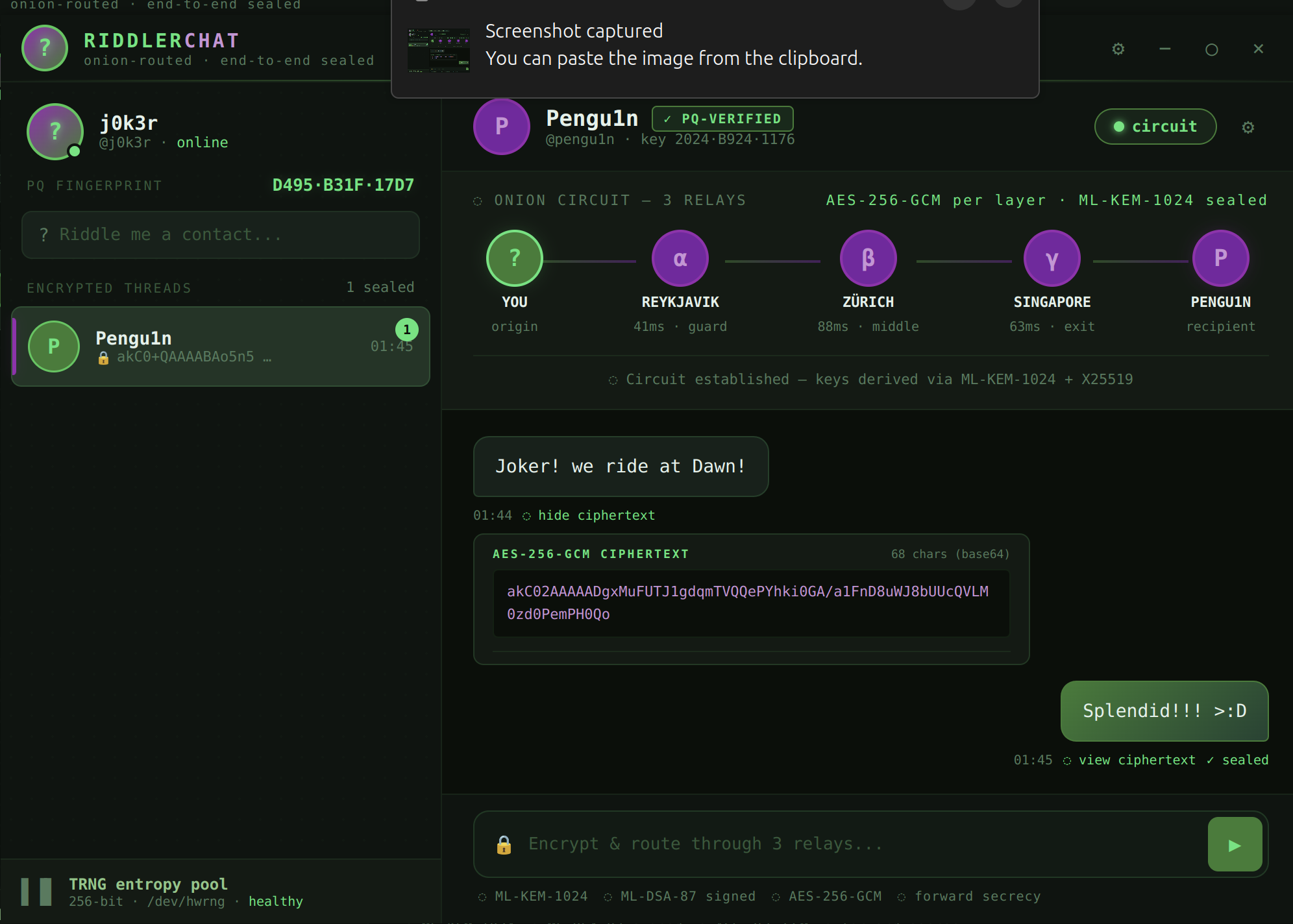
At Oblivion Edge Vulnerability Research, we build tools for the world that is coming, not the world that is comfortable. The Riddler is our custom end-to-end encrypted chat application, built from the ground up to implement NIST's post-quantum standards for secure messaging. It exists because the applications most people trust with their private communications — Signal, WhatsApp, iMessage — still rely primarily on classical key exchange mechanisms that a cryptographically relevant quantum computer would break.
Signal deserves credit for beginning its PQXDH protocol integration, but the transition across the messaging ecosystem remains incomplete and inconsistent. The Riddler was designed as both a functional secure communication tool and a reference implementation demonstrating that post-quantum messaging is not merely feasible but practical today. Every key exchange, every signature, every session renegotiation uses algorithms that will survive Q-Day.
Technical Architecture: Hybrid Defense in Depth
The Riddler employs a hybrid cryptographic architecture that combines classical and post-quantum algorithms in parallel. This design philosophy acknowledges an uncomfortable truth about the transition period: while we are confident in the quantum resistance of lattice-based schemes, they lack the decades of cryptanalytic scrutiny that classical algorithms have endured. A hybrid approach ensures that a catastrophic break in either family — a surprise quantum computer or a surprise classical attack on lattices — does not compromise confidentiality.
For key encapsulation, The Riddler performs both an X25519 Diffie-Hellman exchange and an ML-KEM-768 encapsulation, then combines both shared secrets through a KDF (key derivation function). An attacker must break both the elliptic curve discrete logarithm problem and the Module Learning With Errors problem to recover the session key. For message authentication and identity verification, ML-DSA-65 signatures are generated alongside Ed25519 signatures, providing dual-scheme authentication that survives the compromise of either primitive.
Session management follows a double-ratchet protocol adapted for post-quantum parameters, where each message ratchet step performs a fresh ML-KEM encapsulation to achieve forward secrecy. If a long-term key is eventually compromised — even by a future quantum computer — past session keys remain unrecoverable because each ephemeral KEM ciphertext was discarded after use.
The Lattice Problem: Why Quantum Computers Stumble
The security of ML-KEM and ML-DSA reduces to the Module Learning With Errors (MLWE) problem, which is itself related to finding short vectors in high-dimensional lattices. A lattice, in this context, is a regular grid of points in many-dimensional space — imagine a three-dimensional crystal structure, then extend that concept to seven hundred dimensions.
The Shortest Vector Problem (SVP) asks: given a basis for a lattice, find the shortest non-zero vector in it. In two or three dimensions, this is trivial. In five hundred dimensions, the best known algorithms — both classical and quantum — require time that grows exponentially with the dimension. Shor's algorithm, which devastates RSA and elliptic curves, exploits the periodic structure of modular exponentiation. Lattices offer no such periodicity. Grover's algorithm provides only a quadratic speedup for unstructured search, which is easily neutralized by doubling the security parameter.
This is not merely a conjecture born of ignorance. The lattice problem has been studied since the 1980s, and despite intense attention from the quantum algorithms community, no sub-exponential quantum algorithm has emerged. The mathematical structure simply does not yield to the tools that break number-theoretic cryptography.
Practical Realities: Larger Keys, Measured Trade-offs
Post-quantum cryptography is not a free upgrade. ML-KEM-768 public keys are 1,184 bytes — compared to 32 bytes for X25519. Ciphertexts are 1,088 bytes. ML-DSA-65 signatures occupy 3,293 bytes where Ed25519 needs only 64. These increases are not catastrophic for a messaging application — a few kilobytes per handshake is negligible on modern networks — but they demand thoughtful engineering in bandwidth-constrained environments.
The Riddler addresses these costs through careful protocol design. Initial key exchange bears the full hybrid overhead, but subsequent ratchet steps amortize the cost across messages. Signature verification is batched where possible. The application maintains responsive performance on mobile hardware because the underlying lattice operations, while operating on larger objects, consist primarily of polynomial multiplications that modern processors handle efficiently.
The Clock Is Already Ticking
The most dangerous misconception about Q-Day is that it represents a future threat. In reality, adversaries with long time horizons — nation-states, primarily — are already executing "harvest now, decrypt later" campaigns. Every encrypted communication intercepted today and stored on tape becomes readable the moment a cryptographically relevant quantum computer comes online. Diplomatic cables, intelligence communications, trade secrets with decade-long value, medical records, attorney-client privilege — all of it is being collected against a future decryption capability.
This means that for any communication whose confidentiality must persist beyond ten years, the migration to post-quantum cryptography is already overdue. The Riddler exists because we believe secure communication should not require waiting for the largest technology companies to complete their transition roadmaps. The algorithms are standardized. The implementations are auditable. The only remaining variable is the will to deploy them.
The edge of obsolescence approaches. We intend to be beyond it.
Oblivion Edge Vulnerability Research LLC builds custom security tooling for researchers and defenders. Learn more at https://fortressofsolitude.org.